Authorities vow action to keep minors off artisanal gold mines
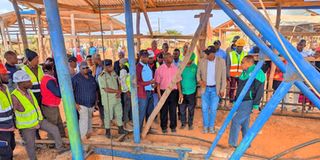
Deputy Minister for Minerals, Dr Steven Kiruswa (second right in blue jeans, a coat and a cap), inspects an artisanal gold mining site during a tour aimed at assessing compliance with mining laws and regulations among small-scale miners. PHOTO | FILE
Dar es Salaam. The government has announced new plans to eliminate child labour in informal and unregistered mining operations where children remain most exposed to hazardous work.
At the same time authorities have also said they now seek to push for universal school enrolment and retention.
Inspection authorities said they are preparing targeted operations in unlicensed mining sites, where children are often engaged in dangerous activities such as carrying ore, transporting water and working in pits.
The move reinforces the government’s position that no child should be employed in mining under any circumstances.
Deputy Minister for Minerals, Dr Steven Kiruswa, told The Citizen that all mining activities must be formally registered and monitored through government systems to ensure compliance with labour and safety regulations.
“Children are not allowed to work in mines. Where violations occur, strict action is taken,” he said.
He noted that most child labour cases are concentrated in informal and unregulated mining operations, where enforcement is weak.
He said authorities will revoke licences of registered operators found violating child protection laws, while illegal miners will be removed and prosecuted.
The crackdown coincides with broader efforts in the education sector aimed at ensuring all school-age children are enrolled and retained in school, particularly in mining regions.
In Geita Region, education officials have intensified campaigns to identify and enrol out-of-school children, saying full enrolment is key to reducing child labour in mining communities.
Authorities attribute child labour cases to weak supervision and gaps in enforcement of labour laws. Some children aged 10 to 15 have dropped out of school, exposing themselves to hazardous work in mining areas.
Tanzania’s legal framework prohibits child labour. Section 5(1) of the Employment and Labour Relations Act (Cap. 366, Revised Edition 2023) bans hazardous child work, while the Law of the Child Act (Cap. 13) provides broader protections for those under 18.
The Mineral Policy of 2009 also mandates strict enforcement against child labour in mining.
However, enforcement challenges persist in remote and informal mining zones where oversight is limited.
Geita Regional Education Officer, Antony Mtweve, said local governments have been directed to identify and enrol all school-age children, noting that free education has reduced financial barriers.
“This is a unique opportunity. The government has removed school fees. What is needed now is close follow-up to ensure every child completes school,” he said.
He added that hostel construction in schools is important for retention, especially for vulnerable children who may drop out due to distance or family instability.
Data from Geita shows mixed progress. Nyang’wale leads with 96 percent pre-primary enrolment, while Bukombe, Chato and Geita Municipality range between 70 and 75 percent. Standard One enrolment has reached 99 percent, with 112,372 of 114,021 eligible children registered.
Despite these gains, dropouts remain driven by unstable families, lack of school meals and migration linked to mining and fishing. Some parents move for work, leaving children unattended.
“There are children living on their own or in difficult conditions. We are placing them in boarding schools where possible,” Mr Mtweve said.
School feeding programmes are being expanded to improve attendance, but detecting child labour remains difficult as some children work in the evenings.
“You may not see them during the day, but at night they go out to work,” he said. He stressed parental responsibility, saying poverty alone does not justify child labour.
“If parents do not take responsibility, children are left to fend for themselves,” he said.
Lwamgasa Ward Councillor Daniel Mabala said communities must change attitudes that normalise child labour, noting that some view out-of-school teenagers as adults expected to work.
“Children are not allowed to engage in income-generating activities. Education is essential for their future,” he said.
Stakeholders, including development partners, are supporting government efforts through school infrastructure, learning materials, bicycles and uniforms for vulnerable children. Lwamgasa Village Chairman Amos Mwita said most Form One students have reported to school, though about 60 remain unaccounted for.
“We are tracking them to establish their whereabouts,” he said.
He urged residents to report children seen outside school, saying community vigilance is essential. Village leaders have also introduced strict measures to enforce attendance, including penalties such as a bag of cement for parents whose children fail to attend school.
“We use the cement for village development projects,” he said.
He added that leaders intervene where guardians are unable to ensure attendance or where children refuse to attend school.
Register to begin your journey to our premium contentSubscribe for full access to premium content