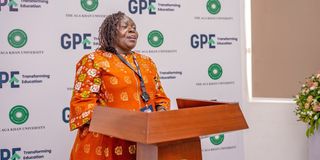
Aga Khan University Institute for Educational Development, East Africa (IED, EA) Interim Dean Prof Jane Rarieya speaks during a regional learning exchange at the universityís campus in Dar es Salaam. PHOTO | COURTESY
Dar es Salaam. East African education stakeholders have called for a rethink of teacher preparation as technology, artificial intelligence, climate change and changing learning needs reshape the education landscape.
The call was made during a Regional Learning Exchange hosted by Aga Khan University’s Institute for Educational Development, East Africa (IED, EA), which brought together teacher educators, policymakers, researchers, school leaders, development partners, student teachers and education practitioners from across the region and beyond.
Held under the theme “Reimagining Teacher Preparation: An East African Learning Exchange on Innovation and Practice,” the exchange provided a platform for participants to share experiences, explore emerging practices and develop practical solutions to strengthen teacher preparation across the region.
The discussions come at a time when education systems are under pressure to improve learning outcomes and equity while responding to rapid technological change, including the growing use of artificial intelligence, climate disruption, increasing diversity and inclusion, and changing expectations of education.
“The future of education in East Africa depends not only on having enough teachers, but on how well we prepare, support and empower them throughout their careers,” said Prof Jane Rarieya, Interim Dean of IED, EA.
“This conference gives us an important opportunity to learn from one another, strengthen partnerships across schools, universities, communities and education systems, and rethink teacher preparation for the realities of today’s classrooms,” she said.
A key focus of the exchange was strengthening teachers’ professional agency so they can play a meaningful role in shaping education reforms.
As education systems increasingly adopt competency-based approaches, participants said teachers need to be equipped to understand learners’ needs, make informed professional decisions, assess learning, adapt teaching methods and collaborate effectively with the communities they serve.
For IED, EA, the exchange also highlighted the need for stronger collaboration among teachers, governments, universities, schools, communities and development partners in reshaping teacher preparation across East Africa.
The institute said this should include strengthening classroom practice and mentoring for student teachers, establishing supportive professional learning communities for early-career teachers, and creating opportunities for experienced educators to mentor others, lead change and contribute to innovation and research.
The exchange is expected to contribute to efforts to develop a more responsive approach to teacher preparation, equipping educators to navigate the changing demands of classrooms while improving the quality and relevance of education across the region.