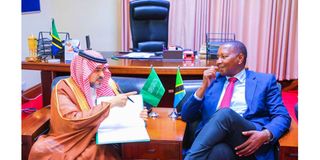
Education, Science and Technology minister, Prof Adolf Mkenda (Right) and Saudi Arabian Ambassador to Tanzania, Yahya Ahmed Okeish, discuss education collaboration strategies, including scholarship opportunities for Tanzanian students. The Saudi Arabia government has increased scholarship slots for Tanzanian students from 90 to 127. PHOTO | COURTESY
Dar es Salaam. For many years, Tanzania has watched talented young people miss out on international scholarships simply because the system did not prepare them adequately to compete, The Citizen has learnt.
The array of obstacles included a lack of timely information, insufficient clarity regarding scholarship prerequisites, and systemic bureaucratic complexity that routinely eliminated even highly qualified applicants during the initial selection phase.
Some applicants did not know they needed international examinations; others learnt about language tests only after deadlines had passed.
A significant number did not have passports when admission processes demanded them, while some, especially from disadvantaged backgrounds, lacked the support required to navigate complex application procedures.
It is against this backdrop that the Ministry of Education, Science and Technology has introduced a new strategy aimed at ensuring Tanzanian scholars no longer remain on the sidelines of global academic opportunities.
Speaking to The Citizen shortly after meeting the Saudi Arabian Ambassador to Tanzania, Yahya Ahmed Okeish, yesterday, Education Minister Prof Adolf Mkenda explained that government assessments had revealed deep structural gaps in how Tanzanians approached scholarships.
He said the country could no longer afford to continue losing opportunities that were meant for its young people simply because the system was not aligned with international standards.
Prof Mkenda recalled that various embassies, including those of Saudi Arabia, South Korea, China, Iceland and South Africa, frequently announce scholarship opportunities for Tanzanian students as well as the government has been engaging these countries for such a collaboration.
Yet even with the recent increase of Saudi Arabia’s annual scholarship slots from 90 to 127, Tanzanians continued to miss out in significant numbers. According to him, the issue was never a lack of ability.
Instead, it was the absence of preparation and a system that assumed students knew what global application processes required. “We realised that simply announcing scholarships is not helping many Tanzanians to seize these opportunities,” he said.
He added: “Sometimes the information does not reach those who need it. Other times, those who receive it do not have the required international examinations or passports at the time of application.”
He added that some embassies had openly shared their concern that while Tanzanian youth struggled to meet scholarship criteria, applicants from countries such as Kenya and Rwanda were taking up their slots with relative ease.
To respond to this gap, the ministry has introduced a more proactive approach under Samia Scholarship Extended to prepare potential beneficiaries long before scholarship announcements are made.
The model has already taken shape with the selection of 50 high-achieving science students who are currently undergoing a 10-month knowledge and preparation camp at the Nelson Mandela African Institution of Science and Technology (NM-AIST) in Arusha.
These learners are being equipped with advanced academic training, language skills, cultural awareness and university admission preparation.
They are also sitting for internationally recognised examinations that are often required by some scholarship-granting institutions.
The government has gone further to assist them with obtaining passports early in the process, ensuring they meet the fundamental admission requirements many universities insist on.
Prof Mkenda emphasised that this initiative was designed to give equal opportunity to all high-performing students regardless of their socioeconomic background.
He said most Tanzanians currently studying abroad were from international schools, which naturally provided students with the necessary exposure and preparation.
While acknowledging this as a positive thing, he said the new government strategy seeks to ensure that students from ordinary public schools, as long as they have the talent, are not left behind.
He described the programme as, “a platform that would allow even the brightest children from low-income households to reach global universities, with the government covering the support they need along the way.”
Applicants who have previously lost out share similar experiences. Ms Rehema Mwakisu recalled missing a full scholarship in Europe because she was unaware she needed an English proficiency test before applying.
Education agents’ comments
Education agents have welcomed the strategy as long overdue. An East African regional expert with Global Study Pathways, Ms Grace Kimani, told The Citizen that Tanzanian students have the potential to compete globally but often approach opportunities too late.
She said the preparation model fills a gap that education consultants have been facing for years. From the Tanzanian perspective, Edu-Kwanza founder Sarfraz Kassam described the number of missed scholarships as “painfully high”, noting that some opportunities required only that students pay for their flight, yet many failed due to inadequate preparation.
He said the government’s new approach would significantly improve Tanzania’s global academic presence within a short period.
Register to begin your journey to our premium contentSubscribe for full access to premium content