Inside Tanzania’s ‘Amali’ pilot reshaping secondary education
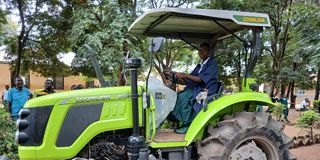
A Form Three student at Msangano Secondary School in Momba District, Judith Baraka, grips the steering wheel of a tractor with quiet confidence. The school is among those selected to pilot the vocational stream in preparation for the two-stream system set for rollout in secondary schools across the country in 2028. PHOTO | JACOB MOSENDA
At Msangano Secondary School, on April 22, 2026, one of 39 pilot institutions implementing the vocational (Amali) stream under the revised Education and Training Policy (2014, 2023 edition), learning has moved beyond chalk and talk. It is now firmly rooted in practice.
“We are not just learning for exams anymore,” said Kesia Juma (17), a student, smiling as she manoeuvred the tractor during a practical session.
“Here, you see what you are studying. You feel it. You can even earn from it in the future,” she added.
The Amali stream, set for full rollout in 2028, introduces a dual pathway in secondary education: the traditional general stream and a vocational track focused on practical skills. At Msangano, the early results are already visible.
According to the school’s head teacher, Ms Flora Kawonga, the shift has transformed both student engagement and school-community relations.
“For the first time, we are seeing students excited to come to school. The Amali classes are interactive, practical, and relevant to their lives,” she said.
The school began piloting the curriculum in 2024 and currently has 155 students enrolled in the Amali stream out of a total population of 498.
Training focuses on three key areas: horticulture, field crop production, and animal health and production.
The impact goes beyond the classroom. Students have already cultivated 18 acres of crops, including maize, beans, sorghum, and rice, which are now helping to sustain the school’s feeding programme.
A game changer
“For years, we struggled with contributions for school meals,” said one parent, Mr Menard Sichalwe, during a community meeting held as part of the Global Action Week for Education (GAWE) 2026.
“Sometimes it led to conflicts or even children dropping out. Now, the school is producing its own food. This burden is being lifted,” he added.
Ms Kawonga echoed the sentiment: “We will no longer get into conflicts with parents and students over meal contributions.”
Teachers, too, are embracing the change. One instructor noted that the new approach has revitalised the teaching environment.
“As teachers, we are no longer confined to theory. We guide students in real-life applications. You can see their confidence growing every day,” he said
Yet beneath the success lie persistent challenges that reflect the broader national picture.
Msangano still faces a shortage of teachers in specialised Amali subjects, with at least one teacher missing in each of the three focus areas.
Infrastructure gaps also remain significant, including the lack of workshops, laboratories, and adequate storage facilities for equipment.
Crucially, the animal health and production component is yet to take off fully due to limited resources.
“We have received substantial support for crop production and horticulture,” Ms Kawonga explained, referencing over Sh366 million disbursed for equipment and learning materials.
“But we still lack livestock, facilities, and tools for the animal health programme,” added Ms Kawonga.
Water scarcity, especially for irrigation during dry seasons, and insufficient ICT infrastructure further complicate implementation.
These realities were at the centre of discussions when the Tanzania Education Network (TEN/MET) delegation visited the school during GAWE 2026.
TEN/MET national coordinator, Ms Martha Makala, held consultations with local leaders, parents, and teachers, focusing on how stakeholders can collectively strengthen the initiative ahead of its national launch.
“This is a golden opportunity for communities. Schools like Msangano can become centres of production, learning, and innovation. We urge parents and leaders to support these efforts fully,” she said.
She added that TEN/MET stands ready to complement government efforts through targeted projects to ensure the effective rollout of the Amali stream.
At the policy level, the government has already taken steps to prepare for the transition, including sending vocational teachers abroad for specialised training, notably to India.