Msimbazi residents’ plea reaches Tanzania, Prime Minister Mwigulu Nchemba, triggers action
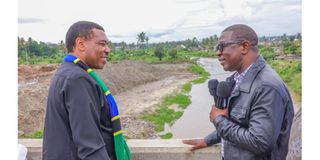
Prime Minister Dr Mwigulu Nchemba (left) listens to Works Minister Abdallah Ulega during an inspection tour of the construction of the Mkwajuni and Kigogo bridges in Dar es Salaam. PHOTO | COURTESY
Dar es Salaam. Msimbazi Valley residents have raised complaints over compensation for the valley development project, alleging undervaluation of their land and low financial payouts by authorities responsible for relocation and the project implementation process underway across the city.
The residents have urged government intervention to ensure land compensation is paid fairly and on time, and to address disparities they claim exist in project implementation across the entire scheme process.
Residents voiced their concerns on Sunday, April 27, 2026, before Prime Minister Dr Mwigulu Nchemba, during an inspection tour of the construction of the Mkwajuni and Kigogo bridges in Dar es Salaam.
In their concerns, residents said that although they welcomed the project with expectations of development, its implementation has caused deep distress due to what they describe as injustice in the compensation process handling system.
A resident of the area, Mr Salehe Cheo, said they initially accepted the project and allowed experts to assess their buildings and land, anticipating receiving appropriate compensation.
“They came, measured, and surveyed our buildings and land. But during payment, they valued buildings only and gave no value to the land. We were given documents to sign without a land component,” said Mr Cheo.
He said efforts to pursue their rights reached the then President’s Office – Regional Administration and Local Government (PO-RALG), but they were advised to go to court, forcing them to escalate complaints to the World Bank (WB), which is financing the project under an ongoing dispute resolution process mechanism review stage.
“What we insist on is that land compensation must be paid. Until now, not even a single citizen has been paid land compensation,” said Mr Cheo.
Another resident said he refused to sign for Sh4 million as compensation for land, explaining that the amount would not enable him to secure another plot to continue his income-generating activities.
“This matter is painful. We are being relocated, but others are left to continue their activities within the project area,” said the resident whose name couldn’t be established immediately.
Ms Nuru Kikopa said the initial valuation awarded her Sh1 million, which she rejected, before it was increased to Sh2.5 million and later accepted.
However, she said she received a total of Sh4 million for the house and plot, funds that have not enabled her to secure new accommodation.
“Up to now, I have done nothing with that money; it does not match the cost of obtaining another plot. I have found myself forced to live with my children,” said Ms Kikopa.
Mr Thomson Moshi said he has not received compensation to date despite being assessed, claiming they were promised payment for land and buildings, but so far, only building compensation has been issued.
“During payment, we were shown a form containing compensation for buildings only, while being promised that land would be paid for later, something that has not been implemented,” said Mr Moshi.
Responding to the claims, Dar es Salaam Regional Commissioner (RC), Mr Albert Chalamila, said the compensation process was conducted in accordance with the area’s legal status, while assuring the government is ready to review the assessment to reach a lasting solution on the said matter.
He said Sh54 billion has already been spent to compensate residents who were living in the valley, as part of the implementation of the development project in the area.
He explained that, under existing laws, residents of the valley were not eligible for land compensation because the entire Msimbazi Valley is classified as a wetland, which, under conditions governing projects funded by the WB, does not permit payment of land compensation.
“Under these laws, no one in the entire Msimbazi River Valley was eligible for land compensation because the area is located in a wetland,” he said.
However, the regional commissioner said that after receiving complaints from residents, the government took an additional step by providing each resident with Sh4 million to help them purchase land in other areas.
He explained that the decision did not arise directly from legal requirements but was an effort by the government to reduce the impact on citizens displaced from their homes.
“That Sh4 million was not provided under the law, but was a measure to help citizens obtain alternative areas,” he emphasised.
Due to continued complaints by some residents regarding the amount and procedures of compensation, Mr Chalamila said the government is ready to revisit the valuation exercise to ensure justice for all parties.
He noted that the exercise could be conducted in collaboration with relevant offices to reassess residents’ claims and examine the possibility of improvements.
“We are ready to repeat this valuation exercise and bring it to your office so that we can obtain an acceptable solution,” he said.
Issuing directives on the matter, Dr Nchemba accepted the RC’s proposal and directed the formation of a team of experts from the Prime Minister’s Office, Regional Administration and Local Government (PMO-RALG), the Ministry of Lands, the Regional Commissioner’s Office, and representatives of residents to resolve the matter.
During the visit, Dr Nchemba inspected progress on the construction of the Mkwajuni and Kigogo bridges and expressed satisfaction with the pace of work.
What Minister Ulega said
Speaking at the site, the Minister for Works, Mr Abdallah Ulega, said the Mkwajuni bridge project, measuring 20 metres in length and 5.5 metres in height, includes 560 metres of access roads.
The project, whose implementation has reached 98 percent, is costing Sh11.6 billion.
It began on February 3, 2025, with a 16-month implementation period and is expected to be completed on May 20, 2026.
Regarding the Kigogo Bridge, he said the project measures 50 metres in length and 8.9 metres in height, with access roads extending 625 metres.
“Its construction began on November 7, 2024, for a period of 18 months and is expected to be completed on May 20, 2026. The project costs Sh17.7 billion, and the contractor has already been paid Sh15.1 billion, while implementation has reached 89 percent,” he said.
Regarding the Jangwani Bridge, Mr Ulega said once completed, incidents of roads being closed due to flooding will become history.
Register to begin your journey to our premium contentSubscribe for full access to premium content