Dar es Salaam. A young woman in Arusha lowers her voice as she recalls the events of October 29, 2025. “I was terrified. We lost relatives, children… I don’t want to be reminded,” she says. Her account reflects a broader unease among young Tanzanians following an election period marked by violence and loss of life.
In response, religious leaders have stepped in to create spaces for dialogue. Since November 2025, an interfaith initiative under the Interfaith Committee of Religious Leaders on Economic Justice and the Integrity of Creation (ISCEJIC) has brought together youth across the country to discuss peace, justice and reconciliation.
The forums, organised by the Muslim Council of Tanzania which is popularly known by its Kiswahili abbreviation as Bakwata, the Christian Council of Tanzania (CCT) and the Tanzania Episcopal Conference (TEC), are designed as non-partisan platforms where young people can speak openly.
They come at a time when the government has established an inquiry into the election violence. The Independent Commission of Inquiry, chaired by Mohamed Chande Othman, was formed by Samia Suluhu Hassan to investigate the deaths and unrest linked to the polls.
International actors have also taken interest. The United Nations’ Special Representative to the African Union visited Tanzania in March 2026 and engaged with President Samia Suluhu Hassan and Foreign Minister Mahmoud Thabit Kombo, the Chande Commission, senior political party officials from the ruling CCM and from the opposition Chadema, ACT-Wazalendo, Chaumma and rights bodies among others.
Besides, the Commonwealth also sent former Malawian President Lazarus Chakwera as its special envoy who recently engaged almost all players in Tanzania’s politics, including visiting opposition leader Tundu Lissu as part of reconciliation efforts.
The interfaith forums began in Dar es Salaam in December 2025 and have since been held in Arusha, Mwanza, Songwe and Mbeya, with plans to expand to other regions. Many of these areas were directly affected by post-election tensions.
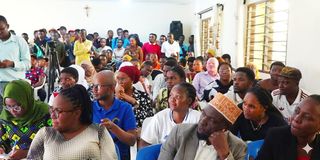
Attendance has been strong, but participation remains cautious. In Arusha, about 300 young people gathered to engage with religious leaders, including Sheikh Khamis Mataka of Bakwata and Bishop Frederick Shoo of the Evangelical Lutheran Church in Tanzania. While discussions were open in principle, many participants hesitated to speak publicly, particularly during livestreamed sessions.
“Freedom of expression is guaranteed in the Constitution, including Article 18, but many young people are not aware of this or are afraid to speak,” said Edmundy Matotay of ISCEJIC.
Some youth described previous experiences that reinforced such fears. One participant said he had been arrested after speaking at a community meeting before the election. He remains reluctant to speak openly, citing concerns for his safety. Others pointed to a climate of self-censorship shaped by recent events.
Despite this, the forums have expanded beyond physical meetings. Organisers are using digital tools, including messaging apps and online discussion platforms such as Jamii Forum, to reach a wider audience and encourage participation.
At the centre of these engagements is a recurring question: should peace come before justice, or vice versa?
Sheikh Mataka told participants that the two are inseparable. “The question is what comes first,” he said, suggesting that peace can create conditions for dialogue and eventual justice.
Bishop Shoo echoed the need for balance. “Peace creates space for engagement, but it should not be used to deny justice,” he said.
Youth participants offered varied perspectives. A young man from Karatu said unrest occurred partly because young people felt unheard. “If youth are not engaged and responded to, frustration can grow,” he said.
Another participant questioned whether leaders are held to the same moral standards taught in religious settings. “People are told to act justly, but we see actions that contradict those teachings,” he said.
Youth affairs expert Israel Elunde urged young people to express their views constructively, noting that participation is a constitutional right. He warned, however, that fear among youth could undermine democratic engagement.
Government spokesperson Gerson Msigwa said authorities support efforts that promote dialogue and unity.
“Without peace, development and reform efforts cannot succeed,” he said, adding that the government remains committed to stability while advancing justice and equality.
Even so, some young people are calling for more direct engagement with policymakers. At a forum in Mwanza, one participant urged the Minister for Youth Affairs, Joel Arthur Nanauka, to create regular channels for communication with young citizens.
Others raised concerns about unresolved cases of abductions and disappearances, arguing that addressing such issues is essential for rebuilding trust.
Faith-based organisations, including Norwegian Church Aid Tanzania, have supported the initiative by strengthening interfaith cooperation and dialogue. Their role has helped sustain the forums as spaces where sensitive issues can be discussed.