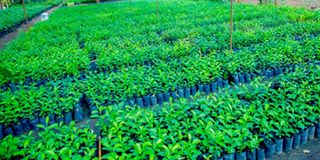
Seedling gap threatens forest restoration goals

What you need to know:

  • Tanzania’s 184 local councils required 276 million tree seedlings during the 2024/25 financial year but Tanzania Forest Service produced only 35 million seedlings

Dar es Salaam. Tanzania’s ambitious plans to restore its forests under the National Development Vision 2050 face a major bottleneck, with a huge shortage of seedlings hampering reforestation efforts.

The gap threatens to undermine efforts to reverse forest loss and meet climate commitments.

A press statement by Tanzania Conservation and Heritage Initiatives (TCHI) shows that the country’s 184 local councils required 276 million tree seedlings during the 2024/25 financial year. However, Tanzania Forest Service (TFS) produced only 35 million seedlings, leaving an 87.3 percent supply shortfall.

The deficit is compounded by inadequate seed collection, with reports showing that between 2021 and 2025, annual collection ranged from 25.3 to 29.4 tonnes, below the national target of 40 tonnes.

TCHI also said planting exotic species such as eucalyptus had yielded limited benefits for farmers because they offered no immediate returns.

In tobacco-growing areas, only 455 hectares had been reforested, a negligible area compared with annual deforestation of 315 hectares in those zones. Further statistics according to TCHI show that Tanzania is losing between 460,400 and 469,000 hectares of forest annually.

Between 2001 and 2025, the country lost 3.7 million hectares of tree cover. In 2025 alone, 250,000 hectares of natural forest were lost, resulting in 88 million tonnes of carbon dioxide emissions. Speaking during a press briefing on the state of conservation, TCHI chief executive officer, Mr Constantine Akitanda, warned that environmental degradation posed not only an ecological threat but also a direct risk to economic survival.

“Without urgent intervention, climate change could reduce gross domestic product (GDP) by four percent by 2050, potentially pushing over 2.6 million people into extreme poverty,” he said, citing Vision 2050 projections. The organisation also highlighted funding gaps, saying the private sector is expected to finance about 70 percent of Vision 2050’s environmental implementation, despite the absence of a specific public budget allocation.

“TCHI calls upon the government to clearly articulate the financial resources designated for resolving human-wildlife conflicts and restoring degraded ecosystems,” said Mr Akitanda. TCHI also raised concerns over escalating water conflicts in the Ngorongoro Conservation Area, where pastoralists, livestock and tourism facilities compete for water during dry seasons. He commended recent joint planning between the Pastoral Council and Ngorongoro Commissioner, Mr Abdul-Razaq Badru, describing it as a model for effective conservation.

“We firmly believe that effective conservation requires the full participation of citizens; without it, sustainability remains unattainable,” he said.

TCHI urged the government to finance water projects outside protected areas, expand seedling production and strengthen enforcement against illegal logging, which it said accounts for 30 to 40 percent of all logging.

“We remain united in our conviction that impactful conservation is inclusive conservation,” said Mr Akitanda.