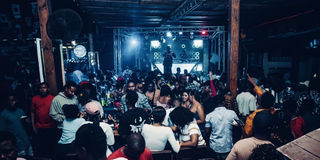
Vibrant nightlife in Dar es Salaam has brought economic and social opportunities but also concerns about excessive noise and its effects on residents’ sleep and health. PHOTO | ISMAIL RAMADHANI
Dar es Salaam. Dar es Salaam’s night-time soundscape is increasingly becoming a public health concern, as rising noise from bars, concerts and entertainment venues disrupts sleep, affects productivity and exposes residents to long-term risks such as stress, hypertension and hearing loss.
Across Kinondoni, Ilala, Temeke, Ubungo and Kigamboni districts, residents say loud music has become a regular feature of night life, particularly over weekends and during public entertainment events.
What was once confined to selected entertainment zones has gradually spread into residential neighbourhoods, placing homes and leisure venues in close proximity.
For many residents, the city’s nightlife is no longer a distant activity but a constant presence that intrudes into domestic life.
Families report disrupted sleep patterns, reduced concentration among schoolchildren, strained work performance and growing tension between neighbours and business operators.
Health experts warn that the situation is not merely a nuisance but a growing public health risk. Prolonged exposure to high-decibel sound is associated with hearing impairment, cardiovascular disease and sleep disorders, with cumulative effects over time.
Under Tanzania’s Environmental Management Act and the Environmental Management (Standards for Control of Noise and Vibration Pollution) Regulations, excessive noise is prohibited.
However, enforcement has remained uneven, with limited monitoring capacity and weak coordination among responsible institutions.
The 2021 Noise and Vibration Pollution Control Guidelines identify noise pollution as a growing urban environmental challenge, particularly in rapidly expanding cities like Dar es Salaam, where population growth, informal development and commercial expansion have outpaced regulatory systems.
Residents in areas such as Sinza, Kawe, Ubungo, Ukonga, Masaki and Oysterbay say entertainment venues are increasingly operating close to or within residential zones, despite repeated complaints to local authorities.
In many cases, bars and clubs operate late into the night with powerful sound systems that carry far beyond their premises, forcing nearby households to endure repeated disturbances.
The issue has now drawn intervention from regional authorities. Dar es Salaam Regional Commissioner Albert Chalamila has directed municipal councils to stop issuing new licences for entertainment venues in residential areas, citing rising complaints over noise pollution and loss of night-time peace.
He said the uncontrolled spread of bars into residential neighbourhoods has created conflict between business operators and residents seeking rest and reflects weaknesses in urban planning enforcement.
Mr Chalamila noted that nightlife was previously concentrated in designated commercial zones, which helped separate entertainment activities from residential areas.
“In the past, nightlife was confined to areas such as Bilicanas and parts of Posta. That arrangement ensured entertainment did not interfere with residential life,” he said.
Mr Chalamila said last week that rapid urban growth and weak enforcement have since allowed entertainment venues to spread into residential neighbourhoods across the city.
“Today in Kinondoni, Ilala and other areas, bars are located next to residential homes. In some cases, they are directly adjacent to households in places like Masaki.”
He directed district and municipal directors to immediately halt issuance of new licences for bars and entertainment venues in residential areas.
“I want this to be clear: where there are residential areas, directors must stop issuing licences for bars in those locations.”
Mr Chalamila warned that failure to enforce zoning rules would undermine efforts to restore order in urban development.
“This is a sensitive issue. If local leaders are not firm, these problems will continue.”
Mr Chalamila also raised concern about growing complaints from high-income areas such as Masaki and Oysterbay, including from members of the diplomatic community.
“Even ambassadors are saying they cannot sleep. If we mismanage these areas, we will create serious problems.”
He said enforcement should ensure entertainment businesses operate in designated zones that do not interfere with residential peace.
“People need rest and fresh minds. Bars should not be clustered in residential areas,” Mr Chalamila said and called for strict action against operators who fail to control noise levels, warning that business licences must not be used to justify excessive sound.
Health concerns
Medical specialists say prolonged exposure to loud music can cause permanent harm to hearing and overall health.
And Ear, Nose and Throat (ENT) specialis.t Dr Khuzema Rangwala, said repeated exposure to high-decibel sound damages sensitive structures in the inner ear, leading to irreversible hearing loss.
“When noise laws are not enforced, the damage is biological and cumulative,” he said.
Dr Rangwala explained that early symptoms include difficulty understanding speech, frequent need to increase volume levels and tinnitus — a persistent ringing in the ears.
“Tinnitus may start temporarily, but it becomes chronic with continued exposure,” he said,adding that noise pollution also affects sleep quality, concentration and mental health, especially among children and working adults.
Dr Rangwala said chronic exposure increases stress hormones, which are linked to hypertension, heart disease, anxiety and depression.
“Sleep disruption weakens immunity and affects children’s learning and emotional development.”
Another ENT specialist, Dr Rizwan Rafeeque, said noise acts as a biological stressor that affects multiple body systems.
“Continuous exposure increases blood pressure and contributes to long-term cardiovascular conditions,” he said.
He added that symptoms such as ringing in the ears and discomfort in noisy environments should not be ignored.
“The impact varies, but prolonged exposure is harmful regardless of perception.”
Residents live with the burden
In Sinza Palestina, shopkeeper Jumanne Ramadhani said loud music from nearby venues often continues until dawn.
“We report the noise, but nothing changes. You cannot even talk inside your house,” he said.
In Mbagala Zakhem, teacher Mariam Juma said sleep disruption has affected her health and work.
“I often do not sleep properly. My heart races and I wake up tired,” she said.
In Sinza Mori, mechanic Kassim Shukuru said weekends are particularly difficult.
“No one sleeps when concerts are on. Children wake up crying,” he said.
Many residents say they have adapted by closing windows, using earplugs or temporarily leaving their homes during major events, but say these measures offer limited relief.
Organisers and enforcement gaps
Event organisers acknowledge challenges in controlling noise levels, citing limited equipment and weak enforcement.
A Dar es Salaam organiser said decibel levels are rarely monitored. “We don’t have equipment and inspections are rare,” he said.
He added that competition among organisers pushes sound levels higher.
“If two events happen nearby, each tries to be louder.”
Concertgoers say loud music is part of the experience but acknowledge the need for balance.
“Inside the venue, loud music is expected,” said Ms Neema Joseph.
Kelvin Msuya said it creates excitement.
“That is what makes concerts enjoyable,” he said.
Regulatory response
The National Environment Management Council (NEMC) says it conducts awareness campaigns while enforcement involves multiple agencies, including municipal councils, police, Occupational Safety and Health Authority (OSHA) and the National Arts Council, popularly known in Kiswahili as Basata.
NEMC compliance manager Hamadi Taimuru said some organisers wrongly assume permits allow unlimited noise.
“We educate organisers on legal limits and health risks,” he said.
Basata said event permits are issued after assessing venues and safety conditions, including sound direction.
However, enforcement remains constrained by limited resources and coordination challenges.
Urban planning concerns
Urban planners say the growth of nightlife has outpaced regulatory systems, with overlapping residential and commercial land use complicating enforcement.
Experts warn that without stronger zoning enforcement, designated entertainment areas and soundproofing requirements, noise pollution will continue to increase.
Public health researchers cite World Health Organisation findings linking long-term noise exposure to cardiovascular disease, sleep disorders and reduced quality of life.
They caution that even moderate but continuous exposure can accumulate harm over time.
Register to begin your journey to our premium contentSubscribe for full access to premium content