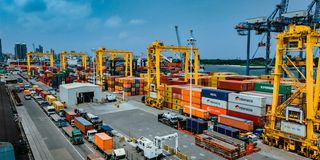
Structured trade and commodity finance, where banks rely on the strength of supply contracts rather than only on collateral, can bring small Tanzanian enterprises into global supply chains
Dar es Salaam. When Tanzania speaks of its 2050 vision and the ambition to build a $1 trillion economy, the focus often falls on visible megaprojects, the Standard Gauge Railway, the Julius Nyerere Hydropower Project and expanding ports.
But, experts have said, behind these concrete and steel symbols lies a less visible force: trade finance.
Speaking to The Citizen during a financial debate roundtable in Dar es Salaam on March 4, 2026, the specialist said trade finance is the funding and guarantees that allow exporters and importers to move goods across borders.
They added that without it, cargo does not sail, factories stall and supply chains collapse.
“Trade finance is no longer just banking plumbing,” said Head of Transaction Banking for Corporate and Investment Banking at Stanbic Bank Tanzania, Mr Tshepo Molete.
“When we finance a railway, a port expansion or an energy project, we are laying the foundation for future trade flows, industrialisation and regional integration. It is the silent infrastructure that will carry Tanzania towards its 2050 Vision,” he noted.
According to the Bank of Tanzania’s Monthly Economic Review (2025), Tanzania’s economy is projected to grow by about 6.4 percent in 2026.
The National Bureau of Statistics shows that total trade in goods and services continues to expand, supported by rising exports of gold, agricultural products and manufactured goods.
China is Tanzania’s largest trading partner overall. Bank of Tanzania figures show trade with China grew by over 12 percent in early 2025, reaching $2.1 billion in the first quarter alone.
Meanwhile, the Tanzania Investment Centre reports that the United Arab Emirates emerged as the leading source of foreign direct investment in 2025, contributing $502 million in new projects in the third quarter.
“These corridors, India, China and the Middle East, will define Tanzania’s trade map to 2050,” Mr Molete noted. “The question is whether we remain exporters of raw materials or move up the value chain.”
An economist and former member at the Economic and Social Research Foundation (ESRF), Dr Hamduni Hamisi, acknowledged that trade finance will determine whether Tanzania industrialises or stays trapped in commodity cycles.
“Financing gold exports is one thing. Financing agro-processing plants, pharmaceutical manufacturing and special economic zones is another,” he explained.
“Trade finance must shift from supporting shipments of raw cashews to supporting factories that process those cashews locally.”
He argued that if Tanzania is to quadruple trade volumes by 2050, potentially reaching combined corridor values above $80 billion, banks must back joint ventures, supply chain finance and export credit guarantees that reduce risk for investors.
“It is about confidence,” Dr Hamisi added. “Investors come when they know payments are secure and supply chains are funded.”
Reducing dollar dependency
Mr Molete stressed that reliance on the US dollar increases transaction costs and exposes traders to exchange rate shocks.
“To reach 2050 targets, we must expand local currency settlements, using the rupee and renminbi where practical. This reduces costs and strengthens regional resilience,” he said.
A development economist based in South Africa, Dr Flora Kessy, agreed. “De-dollarisation in trade, where feasible, protects small exporters from volatility. For SMEs, even a small exchange loss can wipe out margins.”
She noted that structured trade and commodity finance, where banks rely on the strength of supply contracts rather than only on collateral, can bring small Tanzanian enterprises into global supply chains.
“That is how you democratise trade,” she said. “You shift risk from the individual borrower to the broader supply chain.” If ports and railways are the hardware, documentation is the software, they said.
The World Bank estimates that inefficient border procedures can increase trade costs in Sub-Saharan Africa by up to 30 percent.
The experts noted that moving to digital bills of lading and electronic letters of credit could cut clearance times significantly.
“By 2030, most trade documentation should be digital,” Mr Molete further argued. “If cargo moves faster than paperwork, we have a problem. Finance must move at the speed of the SGR.”
The integration of modern ports, railway networks and cross-border payment systems, including links to global platforms such as China’s Cross-Border Interbank Payment System (CIPS), signals a future where transactions settle in hours, not days.
Ultimately, trade finance is not just about loans. It is about trust, speed and risk management.