In biblical hermeneutics, there is a principle known as the “Law of First Mention”. It posits that the first time a concept is mentioned in the text, it carries a fundamental weight, establishing a pattern or a root principle that governs everything that follows.
If we apply this theological lens to the cartography of the city of Dar es Salaam, we find ourselves standing at the gates of Buguruni.
To understand the chaos of our modern sprawl—the “uholela” that defines our outskirts—we must go to the origins. Buguruni is not just another ward: it is the first mention of unplanned urbanism in Tanzania. Solve the Buguruni issue, and you can find a blueprint of the nation’s urban crisis.
The history of Dar was written in the ink of segregation. During the colonial era, the city was a trinity of racial and economic enclaves.
Oysterbay was the sanctuary of the Whites, Upanga and Posta were the domain of the Asians, and Kariakoo was designated for the Swahili—the African pulse of the city.
The birth of Kariakoo itself was an act of colonial convenience. In the 1910s, a sizable market existed in Upanga. However, the colonial masters, sensitive to the “inconvenience” of the Asians, relocated the market to Kariakoo.
This shift sparked a commercial explosion. Kariakoo drew Africans from across the territory, becoming so successful that it eventually lured back the Asian merchants into the Swahili section.
The city planners were meticulous with Kariakoo and Ilala. These wards were surveyed, gridded, and drained. But as the population surged, the planning stopped at the border. People overflowed into the neighbouring lands, and the government simply looked away.
That silence was the birth of Buguruni—the city’s oldest slum. It was the exact moment where uholela began, later creeping like a slow-moving vine into Vingunguti and beyond.
The geography of the jungle
By the 1960s, Buguruni was the extent of the city. Beyond it lay the wild. To younger residents today, it is hard to imagine that just 60 years ago, Kinyerezi was a lion-infested forest.
Even in the 1990s, it was still a village. If you lived in those areas and wanted an education—you moved to the city.
Buguruni developed alongside Uhuru Road, one of the first tarmacked arteries in the country, terminating at Mandela Road.
Because of the lack of planning, the area matured into a dense, informal labyrinth. Today, the original homeowners are elderly or gone, and the ward is now a sea of tenants.
The demographic remains true to its roots: Buguruni is the catchment for the migrant worker, the kibarua arriving from mkoani with a dream and a suitcase.
They seek proximity to the centre. Here, the cost of life is squeezed to its barest essentials. You can still find a room for a monthly rent of Sh30,000 today.
For many, it is simply a place to lay their head at night because the greatest asset of Buguruni is not the roof, but the walking distance to the city centre.
The high cost of the outskirts
Compare this to the modern middle class. In search of “amenities” and “status,” they have fled to places such as Mbweni—30 kilometres away.
They pay a heavy price for this distance, not just in fuel, but in the loss of productivity.
A professional living in Mbweni loses at least three hours a day on the road. That is 15 hours a week. We are burning our most valuable human capital in the gridlocks of our roads.
Meanwhile, a place like Buguruni stares at us from just 4 kilometres away from Kariakoo, and 7 kilometres from Posta.
From Buguruni, one can walk to Kariakoo with ease. It is the ultimate “low-hanging fruit” for urban renewal.
The 400-hectare opportunity
The question, then, is: what do we do with Buguruni? If it represents the origin of our challenge, it must also become the starting point of our response—and that response cannot be incremental.
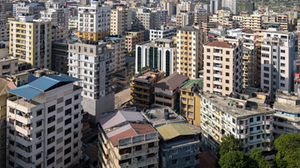
Seen clearly, Buguruni is not just a slum but a 400-hectare inner-city corridor, minutes from the commercial heart of Dar. From Malapa to Sheli, the area spans roughly 1.5 kilometres and houses about 70,000 people in nearly 10,000 largely dilapidated buildings. That is not a problem. It is an opportunity.
If we were to re-imagine Buguruni through the lens of modern, high-density planning, it can comfortably accommodate hundreds of thousands in vertical apartments.
This will be the city within a city catering to the working class—young professionals in the early days of their careers. This will eliminate the Sh5,000 daily commute and replace it with a 25-minute walk.
This is not just about real estate: it is about reclaiming the soul of the city. Buguruni has been a victim of poor planning longer than any other part of Tanzania.
So, we go back to the “Law of First Mention” and we realise that the fix for our national urban crisis must start where the crisis began.
A regenerated Buguruni would serve as a lighthouse for the rest of the country. We shouldn’t push people to the edges while we can build a city right here where it belongs.
Register to begin your journey to our premium contentSubscribe for full access to premium content