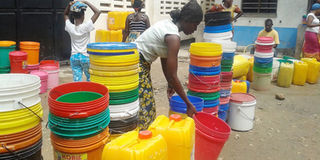
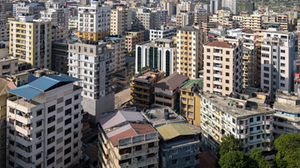
It’s that time again. Dar es Salaam—my city, our city—is gasping. Not from heat, but from thirst. Walk down any street in Tegeta, Ubungo, or Manzese, and you’ll see it: young men and women carrying buckets like weary pilgrims. They’re not fetching water for ritual—they’re surviving.
What looks like work is, in truth, a national subtraction. Every hour spent queuing at a tap is an hour lost to productivity, to dreams, to dignity. And yet, what choice do they have?
The government tells us Lower Ruvu is pumping at “less than 50 percent”. Reality is that it’s less than 20 percent. We’ve become fluent in the language of official euphemism—where “challenges” mean collapse, and “temporary adjustments” mean permanent neglect.
Politicians love this season. They swoop in with fanfare: reviving dry wells, reallocating funds, chasing foreign boogeymen that divert water upstream. Orders are issued left, right, and centre. And it all feels strangely familiar—because it is.
Four years ago, we were told 200 public wells could ease the crisis. Orders were issued. Promises made. And today? We’re issuing the same orders, as if time stood still and accountability evaporated like morning mist over the Indian Ocean.
Here’s the uncomfortable truth: Dar’s water crisis isn’t seasonal—it’s systemic. Since the early 1980s, demand has outstripped supply. Today, the gap is staggering. Officially, the city needs 684 million litres a day.
Some experts say it’s closer to 1 billion. But total production? Just 534 million. Even if every drop reached every home—which it doesn’t—Dar is running a daily deficit of 150 to 470 million litres.
And that “if” is a fantasy.
Because nearly 40 percent of the water Dawasa produces vanishes—stolen or leaked before it ever touches a tap. That’s Sh120 billion down the drain each year. Imagine what that money could build: schools, clinics, jobs. Instead, it’s pooling in cracked pipes and private reservoirs.
Do the math: under best-case assumptions, Dar receives just 48 percent of the water it needs. In reality? Closer to 33 percent. And right now, with Lower Ruvu operating at a paltry 19 percent, supply has plunged to 20–30 percent. No wonder buckets queue like soldiers at dawn.
We face two deficits: a structural deficit and a service deficit. The first is about capacity—simply not enough water. The second is about competence—what we produce never reaches its destination. Shockingly, the service deficit is larger than the structural one.
That means our biggest bottleneck isn’t scarcity—it’s inefficiency. Dawasa isn’t just under-resourced; it’s under-performing. Sources claim that contractors aren’t being paid. As a result, tenders go unbid.
And improving the quality of the distribution network becomes an afterthought. As a result, an organisation with over 7 million customers is just sitting there, as opportunities stare it in the face.
Fixing this doesn’t require miracles—just management. Focus on the right priorities. Patch leaks. Enforce accountability. These are the basic stuff.
As for the structural gap, the answer isn’t secrecy but strategy. Diversify. Stabilise. Scale. The problem is we remain dangerously fixated on one source: expecting the Ruvu River to quench the thirst of 7 million souls and continue to do so for decades to come is wishful thinking.
Yes, the long-delayed Kidunda Dam (now 30 percent complete) will help stabilise waterflow during droughts. But it won’t close the gap. Groundwater in Kigamboni and other areas holds promise—but currently, yields are just 60 million litres a day.
Not near enough. By 2050, Dar will need 2 billion litres of water per day, so our current patchwork—reactive, fragmented, underfunded—won’t cut it.
And yet, there’s something vast, blue, and abundant staring us in the face, and we are not doing anything about it. Namely: the Indian Ocean.
Water desalination isn’t sci-fi. It’s standard practice from Singapore to Israel and Saudi Arabia. Nations are turning seawater into water security—producing billions of litres daily with precision and scale.
So why is it absent from our national conversation? Why do we keep chasing foreign boogeymen upriver while ignoring the ocean at our doorstep?
This isn’t just about water. It’s about political will. About whether we treat citizens as burdens to be rationed or as people deserving of dignity, efficiency, and foresight.
To allow people in a big city such as Dar to be worrying about water in the 21st century – we have to be ashamed of ourselves.
Years ago, I wrote about having certain non-negotiables as a nation. We cannot live without standards.
Yes, as Africans, we may not have it in our blood to manage free and fair elections, allowing our people to have access to the internet as they wish may be too much, education may be too complex a system for us to comprehend, and agriculture may be a mystery to us – so let’s continue importing sugar, wheat, or sunflower oil. But we cannot even manage to supply reliable water?
Guys, really?
Charles Makakala is a Technology and Management Consultant based in Dar es Salaam
Register to begin your journey to our premium contentSubscribe for full access to premium content