Building accountability and sustainability in Longido’s water systems
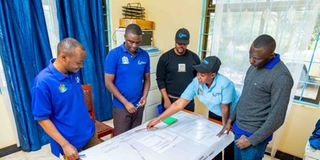
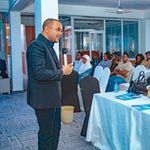
Betty Majele, Community Development Officer, RUWASA Longido (pointing at a section of the map), during a team planning meeting, to locate gravity water supply points.
By Leyla Khalifa and Olivier Germain
“Tumtue mama ndoo kichwani”, “Relieve a woman of the burden of carrying a water bucket on her head”, is a national call to action in Tanzania. In Longido District, Arusha Region, it reflects daily reality for nearly 130,000 people across more than 7,700 square kilometres of vast Maasai land, encompassing wildlife reserves and forests.
Since the Rural Water Supply and Sanitation Agency (RUWASA) was established in 2019, Longido has seen substantial infrastructure growth. Yet reliable water services depend on more than pipes and boreholes, they require robust systems: accurate data, sound finances, and meaningful community involvement.
Long-standing challenges
Progress was long hampered by critical gaps. Engineers lacked precise maps of water networks, forcing teams to spend days surveying parched fields or even digging to locate pipes. “You simply cannot fix or extend pipes without knowing where they begin and end,” explains Paul, a senior RUWASA engineer.
Wildlife, including elephants seeking water, frequently damage infrastructure, causing leaks and the need for major repairs. Community-Based Water Supply Organisations (CBWSOs), responsible for daily operations, face severe financial difficulties. Many connections remain unmetered, relying on flat rates regardless of use, for households, livestock, or both. Unpaid bills are widespread, reinforced by the belief that water, as a divine gift, should be free.
Customers have little influence. Complaint books gather dust, with issues rarely addressed without proper systems to report them. “Until recently, we kept complaints to ourselves because we had no committee to voice them,” recalls Timotheo Gereu, a resident and traditional Maasai leader from Alaililai village. These interconnected issues, poor asset records, revenue losses, and weak feedback, meant services often failed to meet community needs, despite existing infrastructure.
Gaining clarity through assessment
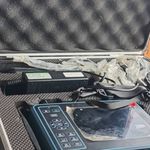
SNV’s WASH Systems for Health (WS4H) programme brought these problems into sharp focus. The Longido RUWASA team visited all nine CBWSOs, covering over 50 schemes, and used digital tools to gather data on infrastructure, customer profiles, and financial practices.
The findings were revealing. “If I have learned one thing, it is that CBWSO staff really lack capacity in financial management, fee collection, and record-keeping,” says Betty Majele, RUWASA’s Maasai community development officer.
The process also uncovered substantial water and revenue losses from unmetered connections and inadequate records. At the same time, it produced accurate network maps, capturing precise locations, distances, and layouts from source to tap, turning week-long fieldwork into minutes.
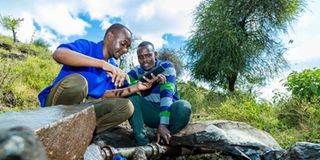
An operator demonstrates the condition of a water storage tank outlet to a RUWASA engineer during routine O&M monitoring in Longido, Tanzania.
Targeted, practical improvements armed with evidence, RUWASA and SNV prioritised three interconnected interventions:
1. Strengthening Financial Management: Reviews exposed urgent capacity needs, prompting rapid action on meter installation for fair, usage-based billing.
2. Enhancing Operation and Maintenance: New maps gave engineers a comprehensive overview, enabling quicker repairs, proactive planning, network extensions and reduced disruptions.
3. Amplifying Community Voice: Longido piloted Participatory Evaluation Groups in five out of 9 CBWSOs. Each group of 6 – 12 volunteers, two from every served village, collects complaints, shares service standards, and follows up on resolutions. “It is easier for people to raise issues with peers than directly with the CBWSO,” Betty notes.
These resource-efficient steps built on existing opportunities, such as assessment visits, to tackle multiple challenges simultaneously.
Early progress and shifting mindsets
Although assessments concluded only in early 2026, results are already emerging. Between December 2025 and February 2026, meters were installed at seven key connections serving schools, a dispensary, and public points. One secondary school, previously failing to pay, paid TZS. 450,000 in fees over two months.
Maintenance is now more precise. “Accurate data will help us make better plans and decisions on infrastructure,” Paul says confidently. Engineers locate issues swiftly and act proactively.
Feedback flows more freely, with some communities creating WhatsApp groups to share photos and trigger rapid responses. “The exercise was a wake-up call,” Paul reflects. “We realised there is still much to do, otherwise the situation will only worsen.”
Voices driving change
The transformation is deeply human, altering how people view water services and their own roles. Betty Majele, a Maasai woman bridging technical and cultural worlds, emphasises action: “We are now shifting from talking to doing. We used to say we need meters but never took the initiative, until now.” She values the independent evaluation groups: “They purely represent the community, giving me accurate information.”
Paul, who joined in 2018, gained new perspective: “We heard about CBWSO and community challenges but did not grasp their full scale until the assessments.”
Timotheo Gereu, a respected Laigwanan and chairman of an evaluation group, embodies ownership. Soon after formation, he reported earthquake damage at the Leikuruki borehole, photographing it and prompting swift RUWASA action. “CBWSOs will now address complaints, knowing an independent group is following up closely,” he says.
Together, these perspectives reveal a shared evolution—from disconnection to collaboration and hope.
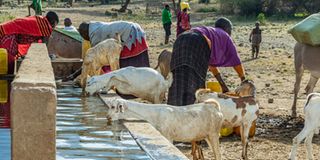
A cattle trough with a specific water schedule used by both livestock and people to get water in Longido’s Lumbwa village, Arusha Region. Asset mapping and the development of water scheme layouts, supported by the WS4H programme, strengthen monitoring, improve maintenance, and the reliability of water services.
A sustainable path ahead
The vision remains: inclusive, financially viable, and dependable water services. Feedback groups will enhance accountability, better data will build resilience, and expanding metering will secure revenue, aligning payments with use and bringing water closer to homes.
RUWASA has drafted guidance urging all CBWSOs to meter every connection and phase out flat-rate points. Systems change demands time and resources, but Longido’s evidence-based, partnership-driven approach is proving effective. When communities pay fairly for water, they value and sustain it.
As Betty, Paul, Timotheo, and others learn from one another and the people they serve, they exemplify true professionalism: not just constructing infrastructure, but managing it responsibly, together with the community.
The WASH Systems for Health (WS4H) programme in Tanzania is funded by UK International Development and implemented by SNV.