As the world marks International Women's Day, conversations about gender equality often focus on the barriers women continue to face in leadership.
In Tanzania, the Jakaya Mrisho Kikwete Foundation (JMKF) is taking a long-term approach to closing that gap by investing in women before they reach positions of power.
JMKF is nurturing a new generation of female leaders through its Young Women Leaders Mentorship Programme, an initiative designed to support emerging professionals aged between 25 and 35 as they navigate the early stages of their careers.
The programme reflects a simple belief that leadership development should begin long before someone enters the boardroom.
In an exclusive interview with The Citizen, JMKF Chief Executive Officer Vanessa Anyoti said the Foundation’s decision to focus on early-career women was driven by a growing realization that the leadership pipeline for women often weakens long before the executive level.
“We believe that leadership development must begin early in a person’s professional journey,” The CEO states. “Across Tanzania, we see a growing number of educated and ambitious young women entering the workforce. Yet their progression into positions of leadership and decision-making remains limited.”
Jakaya Mrisho Kikwete Foundation (JMKF) Chief Executive Officer Vanessa Anyoti instructs young girls during the International Day of the Girl Child’s take over.
While women’s participation in the labour force has grown steadily over the years, their presence in top leadership roles remains comparatively low, she strongly establishes.
Studies and leadership dialogues conducted by institutions such as the UONGOZI Institute indicate that women remain underrepresented in executive management, boardrooms and strategic decision-making spaces across both public and private institutions, she elucidates.
For JMKF, however, the challenge is not a lack of capability among women. The gap we see in leadership representation is not a question of capability but a question of opportunity and access, she further explains.
In Tanzania many women leadership programmes have historically focused on women who are already at managerial or executive levels, she adds and clarifies.
These initiatives play an important role in strengthening women’s leadership at the top of institutions. Yet consultations conducted by the Foundation revealed a crucial gap.
“During our consultations, we observed a missing link in the leadership pipeline,” Ms Anyoti says. “There are very few structured programmes that intentionally invest in women at the early stages of their careers when leadership potential is emerging but has not yet been fully nurtured," she adds.
According to her, it was this insight that led to the creation of the Young Women Leaders Mentorship Programme, which aims to complement existing initiatives rather than compete with them.
While other programmes support women who are already in leadership, this programme focuses on preparing the next generation of women leaders before they reach those positions, she connotes.
Through structured mentorship, leadership training and exposure to experienced leaders from multiple sectors, participants are supported to strengthen their confidence, leadership awareness and professional networks.
“Our strategy is simple,” Anyoti notes, adding, “When you invest in a young woman you strengthen a professional, a household, and a community. When you invest in many young women you begin to transform the leadership landscape of a generation.”
One of the most common barriers young women report is confidence. During consultations with early-career professionals, many participants expressed uncertainty about how to navigate leadership structures or position themselves for advancement.
Many young women felt technically capable in their roles but were uncertain about how to navigate leadership structures, how to position themselves for advancement, and how to build the confidence needed to participate in leadership conversations, Ms Anyoti explains.
To address this, according to her, the programme incorporates mentorship sessions, leadership reflection exercises and discussions with experienced leaders who share both their successes and challenges.
Participants engage in structured mentorship sessions, leadership reflection exercises, and discussions with senior leaders who share their own journeys including the challenges they faced along the way, she says.
She says that participants are also encouraged to implement leadership projects within their institutions or communities, allowing them to apply what they learn in real-world settings.
Confidence also grows through practice, Ms Anyoti hints. Participants undertake leadership projects within their institutions or communities where they apply what they learn.
Over time, the transformation among participants becomes evident.
“Young women who initially hesitate to speak in leadership spaces begin to contribute ideas, lead initiatives, and take greater ownership of their professional paths,” she says.
The programme itself was shaped directly by insights gathered from young women during the Foundation’s consultation process.
Three themes emerged consistently, she elaborates. First, young women wanted 21st century leadership skills and access to mentors who could guide them through leadership transitions.
Second, they wanted to understand how institutions and systems actually function so that they could navigate them more effectively. Third, they wanted safe spaces where they could reflect on their leadership journeys and build confidence.
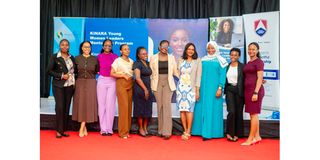
Some of the KINARA Young Women Leadership participants.
Interest in the programme has continued to grow, with organizations across sectors nominating promising young women from their teams.
“We have seen participation from women working across sectors including finance, development organizations, private companies, and public institutions,” the CEO emphasizes.
The energy and commitment of the participants has been one of the most rewarding aspects of the programme. Many come into the programme eager to grow, to contribute, and to understand how they can lead more effectively within their institutions and communities.
As Tanzania’s youthful population continues to expand, with more educated young women entering professional spaces each year, JMKF believes the country has a unique opportunity to shape its future leadership landscape, she adds.
Tanzania has a young population and a growing number of educated young women entering professional spaces. This represents an extraordinary opportunity for the country, Ms Anyoti says.
When these women step into leadership roles in business, public service, civil society, and entrepreneurship, their impact extends far beyond individual success. They influence institutions, inspire other young women, and contribute to shaping the future leadership landscape of Tanzania.