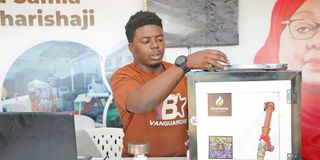
Tanga. Tanzania’s clean cooking drive could soon have another fuel option, as a young innovator develops a system designed to produce clean-burning gas only when it is needed, rather than relying on gas stored in cylinders.
The innovator behind Eco-flame Labs, Lusano Luvanda, believes the on-demand gas-generation system could add another option to Tanzania’s growing clean cooking movement through hydrogen gas.
The innovation is among the technologies that were showcased at the National Education, Skills and Innovation Week in Tanga, where young innovators presented solutions aimed at addressing some of the country’s pressing social and economic challenges.
For Luvanda, the idea is simple: instead of storing large quantities of gas for later use, his prototype is designed to generate the fuel at the point of consumption, potentially offering another pathway towards cleaner cooking and other energy needs. For Luvanda, that difference is important. “If someone needs gas, the machine produces it. Once they use it and the gas runs out, the machine is switched off. When they need gas again, they switch it on and production resumes,” he said.
In simple terms, the machine is intended to produce fuel as it is being demanded, reducing the need for large-scale storage and distribution systems. The innovation is being developed at a time when Tanzania is looking for more ways of moving households away from firewood and charcoal.
Under the National Clean Cooking Strategy 2024–2034, the government has set a target of ensuring that 80 percent of Tanzanians use clean cooking solutions by 2034.
That target makes innovations such as Luvanda’s potentially important—not necessarily as a replacement for existing clean cooking options, but as another technology that could widen the choices available to households and small businesses.
The project is designed for areas with fragmented infrastructure and can operate off-grid. It also aims to use locally available materials, reduce manufacturing costs and minimise the need for specialised maintenance. The university graduate says much of the fabrication is being done locally.
“We make it here locally. It is not that we import the entire machine. We manufacture the components here and assemble the system ourselves,” he noted.
The environmental argument is equally central to innovation. According to the innovator, the system is intended to produce a clean-burning fuel whose combustion leaves moisture as the by-product, while its chemical by-product can potentially be recovered and recycled into industrial supply chains.
The project therefore seeks to combine cleaner energy with a circular approach to resource use. But moving from a promising prototype to a product used in homes is a much bigger challenge.
Luvanda said his immediate ambition is to get the technology ready for the market, with December 2026 as his target for beginning commercialisation.
“We expect to enter the market in December. We need more support to help us bring the product to market, as well as technological support to enable us to further develop this work,” he said. That is where government support for young innovators becomes important.
COSTECH has increasingly been positioning itself not only as a promoter of research and innovation, but also as a bridge between promising ideas and the market.
Through the National Fund for Science and Technology (NFAST), the Commission supports researchers and innovators, while the Samia Innovation Commercialisation Fund has been established to help turn research and innovation into market-ready products.
COSTECH Director General Dr Amos Nungu described the commercialisation support as a mechanism for turning innovations into practical solutions, saying: “This initiative is not just a financial mechanism—it is a catalyst for turning academic research and innovations into real-world solutions.”
The government has also allocated Sh4.6 billion through the Samia Innovation Fund to support the protection, registration and commercialisation of innovations developed by young people, underscoring the growing emphasis on taking ideas beyond exhibitions and into the economy.
For Luvanda, the Tanga exhibition is therefore more than a chance to display a machine. It is a step towards testing whether an idea developed locally can eventually become a locally made product.
His prototype therefore arrives at an important moment. As Tanzania works towards getting eight out of every 10 people onto clean cooking solutions by 2034, the country will need not only more consumers of clean energy, but also more Tanzanians capable of designing the technologies that will power that transition.
Register to begin your journey to our premium contentSubscribe for full access to premium content