Pay in every week, borrow when your turn comes, and put the money into something that will not strip the nearby hills or deplete fish stocks in Lake Tanganyika.
Kapalamsenga, a ward in Tanganyika District, Katavi Region, is not a place that waits for outside rescue. On a market morning you will see a blue cash box on a veranda, a ledger on someone’s lap, and twenty or so neighbours counting out small notes.
They call their savings circle Tujitegemee, which means “let us rely on ourselves”. The loans are tiny and the rules are simple.
Pay in every week, borrow when your turn comes, and put the money into something that will not strip the nearby hills or deplete fish stocks in Lake Tanganyika.
Lately, the most popular purchase is a small gas stove. That choice seems domestic. It is actually ecological.
Each stove is a bundle of firewood left uncut in Kapalamsenga’s community forest, a quiet line of trees that ties village land to the riparian corridors that chimpanzees still use between Mahale and the wider landscape.
This is what climate adaptation looks like when it is owned by citizens. Lake Tanganyika is warmer, with its seasonal mixing less reliable, and near-shore productivity less predictable. When fishers have to work longer nights for smaller hauls, pressure shifts uphill. Families look to woodlots for charcoal or to the forest for quick cash.
Savings circles hold the line by giving people a lawful way to meet a sudden bill without raiding tomorrow’s trees. The conservation benefit is not a slogan. It is time saved, smoke reduced, and a path that does not run through a protected gully.
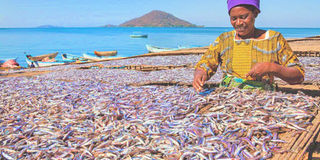
On the water, the state has begun to meet that citizen effort with steadier enforcement. New patrol boats for Beach Management Units on Lake Tanganyika in Kigoma Region are not a luxury. They are fairness made visible.
Legal gear has a chance when everyone knows it will be checked. Closed seasons and mesh sizes matter when the rules are seen to apply to all. When enforcement is consistent, a household that has borrowed for a stove or a set of beehives can stay the course because the market rewards legal work.
There is a broader lesson here for national policy. We often speak about biodiversity and food security as if they compete. In Mahale, they are the same problem solved in two places.
The lake feeds families when rules are credible. The forest carries chimpanzees when people have everyday alternatives to cutting.
The strongest tool for both is a village institution that moves a decision from abstraction to practice. Save, borrow, repay, repeat. With each cycle, the social norm shifts a little further from wood smoke to clean flame, from snared meat to market fish, from bare stream banks to shaded crossings.
Partners matter, but only when they understand their place. Technical support, training in how to run a savings group, seed materials for trackers, and patient environmental teaching are useful precisely because they sit behind the community. The Frankfurt Zoological Society has decades in Mahale. Its value is continuity.
When a ranger transfers or a council changes, the meetings still happen, the cash box still opens, the corridor still gets walked, and the map still holds a thin line where trees should stand. The credit for ideas and choices belongs in Kapalamsenga. The role of a partner is to keep the scaffolding standing while people build.
If we want proof that this model works, we should ask for it in the simplest form possible. Each quarter, a one page note from the village can list households that switched to gas, loans issued and repaid, seedlings planted along streams, and incidents with wildlife that were resolved peacefully. Beach committees can record patrol days and seizures, and the trend in legal catch through the season.
Nothing here requires a consultant. It only requires a habit of telling the truth in public.
Jasper A. Kwayu is a communications strategist based in Dar es Salaam.