How Zanzibar Vice President Hemed calmed union controversy
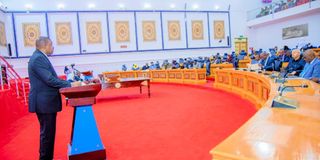
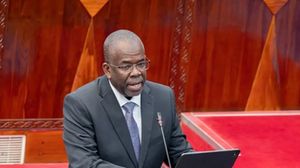
The Second Vice President of Zanzibar, Hemed Suleiman Abdulla, addressing the House of Representatives while presenting a motion to adjourn the House at Chukwani, Unguja, Zanzibar. PHOTO | STATE HOUSE
Unguja. Zanzibar’s Second Vice President Hemed Suleiman Abdulla has moved to calm controversy over employment, health insurance, and union affairs, reaffirming that services and opportunities will be provided without discrimination across the United Republic of Tanzania.
He made the remarks on Tuesday, June 23, 2026, when he adjourned the Third Session of the 11th House of Representatives, concluding debates that had triggered heated discussion inside and outside the House.
The debate was sparked by remarks on a range of issues, including claims that non-Zanzibaris were accessing health services in Zanzibar using insurance cards, concerns over the employment of non-local workers in hotels, and broader questions on equity in resource sharing within the union.
The controversy gained traction after Acting Minister for Health, Dr Saada Mkuya Salum, was quoted as questioning the use of Zanzibar health insurance cards by non-residents, noting that the semi-autonomous region’s Sh8 trillion budget could not sustainably cover healthcare for more than 60 million people.
Separately, Deputy Minister for Youth, Employment and Empowerment, Mr Hassan Khamis Hafidh, told the budget session that a large proportion of workers in Zanzibar’s 1,184 registered hotels were non-Zanzibaris, calling for greater empowerment of local youth.
Some legislators argued that defending Zanzibaris in such terms amounted to discrimination that could strain the union, while others insisted the union remained beneficial and must be safeguarded.
Mr Hemed said the debate was being driven by individuals seeking attention, warning that such narratives would not succeed in weakening national unity.Union
He said the union remains the cornerstone of peace, stability, and development in the country.
“The union is not only historical; it is deeply rooted. We have not only mixed soil, but we have also mixed blood through marriages,” he said.
He stressed that citizens from both sides of the union continue to enjoy equal opportunities in social, political, and economic life.
“The Zanzibar government, through the Revolutionary Government of Zanzibar (RGZ), and the Government of the United Republic of Tanzania (URT), continue to cooperate closely in advancing national interests,” he said.
He cited progress in resolving union-related matters, including a Joint Committee (JC) meeting held in Zanzibar on April 26, 2026, which resolved a long-standing sugar trade dispute between Zanzibar and mainland Tanzania.
He said this brings the number of resolved union issues to 23 out of 25.
“This is a sign of unity, cooperation, and the success of our union founded in 1964 by Mwalimu Julius Nyerere and Sheikh Abeid Amani Karume,” he said.
Mr Hemed assured citizens that both governments will continue to safeguard and strengthen the union for the benefit of all Tanzanians.
“There is no discrimination that will be allowed on either side of the union. Citizens from Zanzibar live, own property, and have families in mainland Tanzania, and vice versa,” he said. He cautioned against using union matters for political gain or social media popularity, warning that such actions risk undermining national cohesion.
Health insurance
On universal health insurance, Mr Hemed said ongoing reforms aim to ensure equitable and sustainable access to healthcare without financial barriers. He said Zanzibar has established its framework under the Zanzibar Health Services Fund Act No. 1 of 2023, requiring all residents to register regardless of income or employment status.
He added that mainland Tanzania has enacted the Universal Health Insurance Act No. 13 of 2023, creating a national system for broader coverage. He urged citizens to register under their respective schemes to improve access to healthcare and reduce out-of-pocket costs.
“Those with Zanzibar cards will be treated in mainland Tanzania, and those with NHIF in mainland Tanzania will be treated in Zanzibar. Registration is free and straightforward,” he said.
He said the goal is to ensure citizens can access healthcare anywhere within the union without difficulty.
Employment
On employment, Mr Hemed said Zanzibar has created an enabling environment for both self-employment and formal jobs in the public and private sectors.
He said opportunities are open to all qualified individuals without discrimination based on origin, religion, ethnicity, or political affiliation.
“We do not consider whether someone comes from mainland Tanzania or Zanzibar. If they qualify, they will be employed,” he said.
He urged public institutions to strictly adhere to laws, regulations, and procedures when allocating opportunities. The House was adjourned until Wednesday, September 9, 2026.
Register to begin your journey to our premium contentSubscribe for full access to premium content