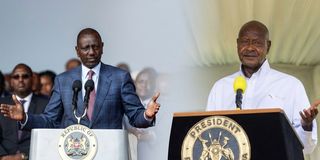
Kenyan President William Ruto and Uganda’s President Yoweri Museveni are currently trying to solve the same problem: how to produce a good report card.
Ruto, 59, has an election coming up in August 2027, and he is collecting receipts on his development record. Museveni, 82, has been in power for over 40 years and was sworn in this May for a ninth term that will see him clock 45 years in office when it runs out in 2031. He, too, is working on a report card; except his is a legacy document.
Cracking down on corruption, or appearing to, is central to how both leaders are building their credentials. And on that front, the difference between the two countries is night and day.
Part of the difference comes down to who steals, how much they steal, how they steal it, and how the state wants the story told.
Since 2022, Kenya’s anti-corruption fight has leaned on a much-publicised strategy of civil asset recovery, with the Ethics and Anti-Corruption Commission (EACC) aggressively freezing and forfeiting billions in “unexplained wealth” without waiting for lengthy criminal convictions.
This has produced high-profile crackdowns on powerful figures, including former governors, along with some reforms within the judiciary itself.
Yet corruption in Kenya still thrives, because it is sophisticated, hidden behind intricate procurement rings.
Auditors have flagged Tsh377.5 billion ($143 million) in irregular payments and penalties at KETRACO alone, with a further Tsh208.6 billion ($79 million) network exposed in the Ministry of Health. Untangling these deeply embedded, multi-billion-shilling institutional networks remains a formidable challenge for the anti-corruption brigades.
Uganda isn’t talking about asset recovery. Because the graft there has bred and grown fat over 40 years of Museveni’s rule, there’s a greater need to trumpet any anti-corruption action from the hilltops, to make a spectacle of it.
The takedown of former Speaker of Parliament Anita Annet Among, easily the most flamboyant person to hold that office in East African history, was one for the ages.
Timed to scupper her re-election bid in the new parliament, her luxury properties around Kampala and upcountry were raided by military special forces.
Her fleet of cars, including a custom-built 2025 Rolls-Royce Cullinan valued at over Tsh1.16 billion ($440,000) and two Mercedes Benz S500s worth roughly Tsh1.85 billion ($700,000), was paraded through Kampala on the backs of trucks as people snapped away and posted it all online.
Even her Oscar de la Renta dresses, some costing over Tsh39.6 million (US$15,000), got a mention.
The very public humiliation was necessary to satisfy a people’s long-held craving for a few crooks’ scalps. After a few people have been thrown into the hyena’s den, the purpose will have been served, and few prosecutions will follow.
But it also exposed a telling difference in how Kenyans and Ugandans eat. Take the Eurobond scandal, born of Kenya’s historic Tsh5.28 trillion ($2 billion) debut sovereign bond issued in June 2014 under President Uhuru Kenyatta’s government.
It became one of the defining financial controversies of the late 2010s and early 2020s, as opposition leaders and civil society groups alleged that nearly half the proceeds (about Tsh2.64 trillion ($999 million)) had vanished, with large sums allegedly parked in offshore accounts in New York and Qatar rather than Kenya’s Consolidated Fund.
Chasing the Eurobond was a health hazard: in the end, most people who dug hard enough came away with a migraine and precious little incontrovertible evidence. That’s how sophisticated it was.
Uganda’s corrupt are more practical, more down to earth. You can see their spoils: houses, cars, things you can touch. Former Speaker Among probably owned more real estate than every Kenyan Speaker combined.
Around the country, they keep stumbling across absurd displays of graft. A local government minister touring eastern Uganda to sniff out corruption was shown a tiny latrine enclosure that had supposedly cost Tsh47.0 million ($17,800), with no pit ever dug.
In the north, previous reports revealed billions were spent on a stadium that turned out, once the money had been chewed through, to be little more than a cowshed beside an open field.
Not far away, a sugar factory that has swallowed hundreds of millions of US dollars (billions of Tanzanian shillings) in government funding, year after year, has yet to produce a single spoonful of sugar. Someone, somewhere, is licking the spoon clean before it arrives.
For Museveni, that’s the complication: four decades of graft have piled up on his watch, and no amount of spin will fully bury it. Still, he has one advantage Ruto might envy.
Kenyans have turned covering their tracks into an art form: a maze of shell companies, offshore transfers and plausible deniability. Ugandans, by contrast, park the evidence in the driveway. Given the choice between chasing ghosts and chasing Rolls Royces, the EACC could be forgiven for wishing its thieves were a little more Ugandan.